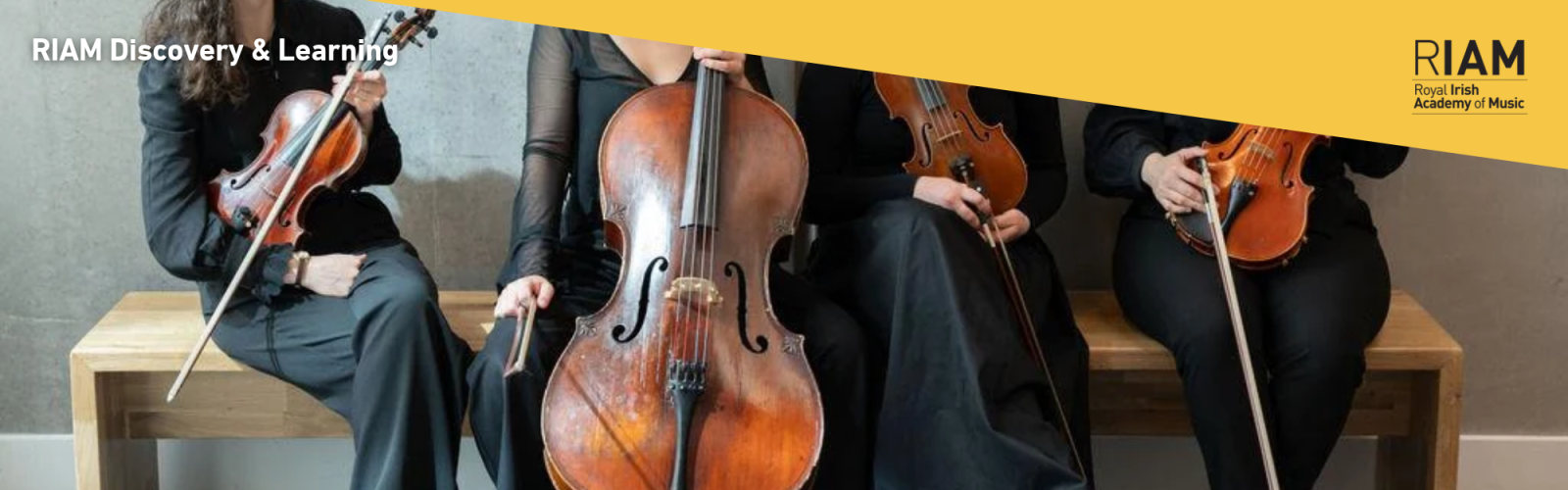
Course featured image
Inside the String Quartet: Unlocking Beethoven’s Op. 18
-
Date(s)Fridays 29th January - 26th February 2027
-
Duration5 weekly sessions
-
Time11:00 - 12:15 PM
-
Mode of DeliveryIn Person
-
VenueRIAM
-
Fee€100
Course Introduction
Description
A five-week journey led by RIAM’s Head of Chamber Music, Professor Sarah Sew, explores the profound artistry, hidden structures, and musical innovations in Beethoven’s first six string quartets, Op. 18.
Composed when Beethoven was in his late 20s, the Op. 18 quartets, traditionally called the "Early Quartets", represent an important moment in music history. This immersive series features live, in-lecture musical demonstrations by four RIAM ensembles: the Féinics, Tara, Sonic and Atlas String Quartets. Experience live acoustic analysis – instead of listening to recordings, you will see and hear a live string quartet deconstruct the music, demonstrate specific motifs, harmonic shifts and the dramatic tensions that make Beethoven an unmistakable musical voice.
The lectures will illuminate how Beethoven’s Op. 18 String Quartets act as a bridge between the traditions of Haydn and Mozart, yet still show hallmarks of the radical Beethoven who would go on to compose his revolutionary late quartets on which Franz Schubert commented “After this, what is left for us to compose?”
This course includes a FREE 'Access All Areas' Ticket to Student Performances as part of RIAM’s Beethoven 200 Season in 2027
Course Schedule:
Friday 29th January 2027
Session 1: Classical Beginnings (Guest Performers: Féinics Quartet)
The opening session orientates you into Beethoven’s world in the 1890s following the death of Mozart and Haydn’s completion of his final set of quartets. The Féinics Quartet will demonstrate excerpts from Beethoven’s first completed quartet, Op. 18, No. 3 and arguable his most “Classical” quartet, Op. 18, No. 2 demonstrating influences and connections with Haydn as the inventor or “Father of the String Quartet”.
Friday 5th February 2027
Session 2: Romeo and Juliet (Guest Performers: Tara Quartet)
The second session focuses on the quartet Beethoven chose for his debut in the published set: Op. 18, No. 1. We will explore the remarkable innovation of its opening movement, which uses a concise six-note motif in dozens of ways to constantly reinvent the musical material. The lecture also examines Beethoven’s sketches and letters, revealing how the tomb scene in Shakespeare’s Romeo and Juliet inspired the tragic slow movement.
Friday 12th February 2027
Session 3: Sturm und Drang (Guest Performers: Atlas Quartet)
Focusing on Beethoven’s only minor-key quartet in the set, this lecture examines Op. 18, No. 4 in C minor and the principles of Sturm und Drang ("Storm and Stress"). We will explore its connections to Mozart’s turbulent String Quartet in D minor, K. 421, from the famous set Mozart dedicated to his mentor and friend, "Papa Haydn".
Friday 19th February 2027
Session 4: Homage to Mozart (Guest Performers: Sonic Quartet)
This lecture examines Beethoven's String Quartet in A major, Op. 18, No. 5. We will trace how Beethoven modelled the work directly on Mozart’s Quartet in A major, K. 464 – another masterpiece from Mozart's "Haydn" Quartets – comparing how both composers handle structure, counterpoint, and a central theme-and-variations movement.
Friday 26th February 2027
Session 5: La Malinconia – The Melancholy (Guest Performers: Sarah Sew performing side-by-side with students)
Written at the turn of the new century, Beethoven’s final quartet in the Op. 18 set features a haunting, slow introduction to the finale titled La Malinconia, marked with instructions to the performers: questo pezzo si deve trattare colla più gran delicatezza ("this piece must be treated with the greatest delicacy"). This lecture explores how Beethoven shifts between extreme emotional states using bold harmonic and dynamic innovations. The final session also offers insight into the different ways string quartets are taught at the RIAM, demonstrating the "side-by-side" teaching model.
Tutors
Prof. Sarah Sew Head of Chamber Music (MMus, BMus, DipRAM, LRIAM, ARIAM)
Sarah Sew is Professor of Violin and Head of Chamber Music at the Royal Irish Academy of Music, where she founded its flagship festival, ChamberFest Dublin in 2019.
Sarah is recipient of the Maisie Lewis Young Artists’ Fund Award which supported her recital debut at the Wigmore Hall, the Emanuel Hurwitz Award for an outstanding UK violinist and the J & A Beare Prize. As a recitalist and chamber musician, she has performed at Zermatt Festival, Switzerland; Bolzano Festival, Italy; Grafenegg Festival, Austria; Cheltenham Festival, UK; and the International Musicians Seminar, Prussia Cove. Sarah is a member of the newly formed Kantos Quartet, who recently gave their debut tour supported by the National String Quartet Foundation.
Sarah is also Leader of the Irish National Opera Orchestra and has appeared as Guest Leader of the National Symphony Orchestra Ireland, BBC Symphony Orchestra, English Symphony Orchestra, Balkan Chamber Orchestra, and the Human Rights Orchestra in Lucerne amongst others. Previous positions include Concertmaster of the European Union Youth Orchestra and Principal First Violin of the RTÉ Concert Orchestra.
Sarah studied with Maurice Hasson and Howard Davis at the Royal Academy of Music in London and Friedemann Eichhorn at the Hochschule für Musik Franz Liszt Weimar, Germany. In 2018, she was awarded Associate of the Royal Academy of Music. She appears frequently on competition juries and returned to Weimar in 2022 as a jury member for the International Louis Spohr Competition.
Sarah plays an Italian violin by Gennaro Gagliano c.1760.